There is still no final federal OSHA heat standard: the rule proposed in August 2024 remains in post-hearing review, the department has declared an intent to finalize it, and no date is set. What governs today is the General Duty Clause plus state heat rules – and the practical question employers keep asking is what to have in place right now. This guide gives the honest status, the requirements that already apply, and the heat communication program that holds up either way.
Put it practically: if tomorrow’s forecast says 95°F, what exactly goes out to your employees, who sends it, and what record will you have if OSHA asks about it in October? That is the gap this guide closes.
Table of contents
1. Where the federal heat rule stands
2. What is actually required right now
3. What the proposed rule would require
4. The heat communication program
5. Template: heat-day communication plan
6. The mistakes that get employers cited
7. The bottom line
8. Frequently asked questions
Where the federal heat rule stands
The status, from the official rulemaking docket:
- Aug 30, 2024 – the proposed rule (“Heat Injury and Illness Prevention in Outdoor and Indoor Work Settings”) published in the Federal Register.
- Jun 16 – Jul 2, 2025 – informal public hearing; Oct 30, 2025 – post-hearing comment period closed.
- Apr 8, 2026 – the Heat National Emphasis Program expired after its extension ran out.
- 2026 – the Department of Labor’s regulatory plan states an intent to finalize the standard; no target date has been published.
Translation: a federal standard is coming in some form, on an unknown clock. Waiting for it is not a heat program.
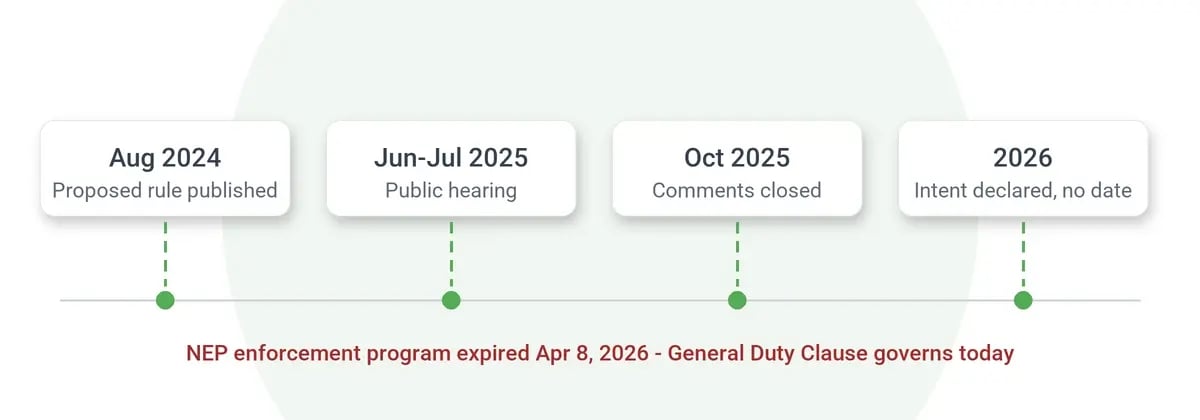
In short: The federal heat rule is proposed, not final. Today employers answer to the General Duty Clause and any state heat rules that apply.
What is actually required right now
Two layers apply today:
The General Duty Clause. Even without a heat-specific standard, OSHA cites employers for recognized serious hazards – and heat is a recognized hazard with published federal guidance. A defensible position is a documented program: hazard assessment, water/rest/shade practices, acclimatization for new and returning workers, training, and records showing employees were actually informed on hot days.
State heat rules – already binding where you operate:
- California – outdoor heat illness prevention since 2005 and an indoor heat rule since July 2024 (Cal/OSHA).
- Washington – outdoor heat exposure rules with employer duties (L&I).
- Oregon – heat illness prevention rules for outdoor and indoor work (Oregon OSHA).
- Minnesota regulates indoor heat, and Colorado covers agricultural work – and more states are drafting. Confirm what applies to your sites with counsel.
In short: If you operate in California, Washington, or Oregon, binding heat rules already apply to you. Everywhere else, the General Duty Clause still expects a documented heat program.
What the proposed rule would require
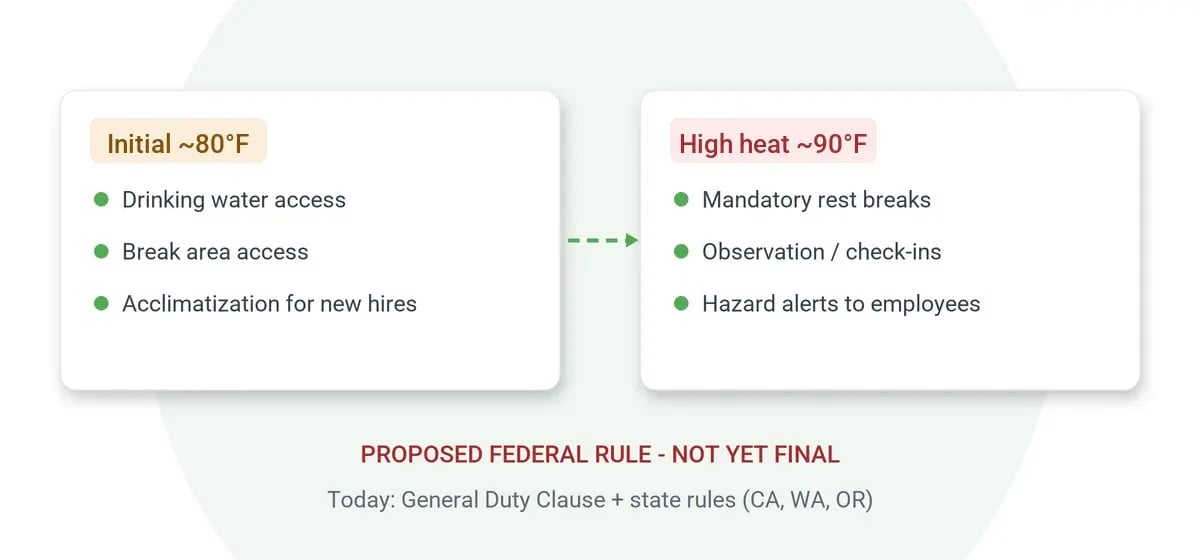
Everything in this section is proposed, not yet required – but building to it now means complying once instead of twice. The proposal’s core elements:
- A written heat injury and illness prevention plan with a designated coordinator.
- An initial heat trigger around 80°F – drinking water, break access, and acclimatization protections for new and returning employees.
- A high-heat trigger around 90°F – mandatory rest breaks, observation or communication measures for signs of heat illness, and hazard alerts to employees.
- Training on symptoms, first response, and the plan itself, refreshed annually.
- Coverage of indoor work settings as well as outdoor.
The pattern to notice: at both triggers, the proposal expects the employer to tell employees things at specific moments – which is exactly the part most heat programs improvise.
In short: The proposed rule is not in force – but its structure (written plan, 80°F and 90°F triggers, acclimatization, training) is the safest blueprint to build on now.
The heat communication program
Heat safety is a scheduling-and-reminders problem wrapped in a policy. The communication layer that makes a program real:
- Season kickoff. One notice to every affected employee: the program exists, here are the triggers, here is where water and shade are, here is who to call. Delivered to screens and phones, not a poster in the break room.
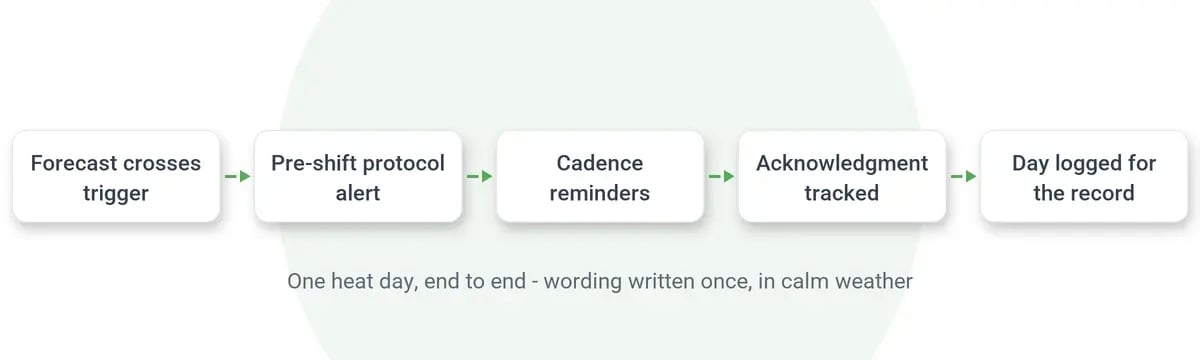
- Heat-day alerts. When the forecast crosses your trigger, the day’s protocol goes out before the shift: hydration cadence, break schedule, buddy checks. Alerts can be sent manually, on a schedule, or fired through the API from your monitoring or weather tooling.
- Cadence reminders during high heat. Short recurring reminders – drink, rest, watch your crew – on the interval your plan names. Wording written once, in calm weather.
- The record. Delivery and acknowledgment logs show who was informed and who confirmed on which day – the communication evidence a General Duty Clause defense or a state inspection asks for, created at send time.
Wording, channel, and habit: start from our weather message templates, deliver through emergency notification software that reaches desktops, mobile devices, and signage, and rehearse the path in workplace drills before summer does it for you.
Working scenario – one heat day
Before:
- Supervisors text crews one by one, coverage unknown
- Paper sign-off sheets collected days later
- No record of who was actually told, or when
After:
- Pre-shift protocol alert to the affected shifts
- Reminders on the cadence the plan names
- Delivery and acknowledgment log exported for the record
Case study
Manufacturing: safety alerts with automatic records
Safety messages for hazardous conditions go automatically to the affected production areas, and every delivery is logged – the informed-employee record a heat program needs is created at send time.
Read the manufacturing case study ›
Template: heat-day communication plan
One table your plan can adopt as-is. Fill the triggers from your own policy (or the proposed rule’s 80/90°F as a starting point).
Heat-day communication plan
| Trigger | Message | Audience | Cadence |
|---|
| Season start (date) | Program notice: triggers, water/shade map, contacts | All affected employees | Once + on hire |
| Forecast ≥ initial trigger | Heat-day protocol: hydration, breaks, buddy checks | Affected sites/shifts | Before shift start |
| Forecast ≥ high-heat trigger | High-heat measures + symptom watch + who to call | Affected sites/shifts | Before shift + recurring reminder |
| Heat illness sign reported | Response instruction to the area; first-aid dispatch | Area + responders | Immediately, with acknowledgment |
| End of episode | All-clear / return to normal schedule | Same audience as alerts | Once |
Log every send and acknowledgment against the date – that column is your inspection evidence.
The mistakes that get employers cited
Patterns that recur in heat-related citations and inspections:
- The plan exists, the communication does not. A written program with no evidence anyone was told anything on the hot days it covers.
- No acclimatization for new and returning workers. OSHA’s guidance singles them out as the highest-risk group – a program that treats all workers identically misses the point inspectors check first.
- Water and shade exist but are not verifiable. If access is not documented and communicated, it is your word against the citation.
- Training happened once, with no records. Undocumented training is treated as no training.
- No named owner. When the coordinator is “the safety team,” trigger-day decisions arrive late or not at all.
The bottom line
The federal heat rule is declared, drafted, and undated – but the duty to protect employees from heat is already here, through the General Duty Clause and the state rules. The program that satisfies both today and the eventual standard is the same: written plan, real triggers, acclimatization, training – and communication that went out on time, with delivery and acknowledgment records for the day it mattered.
When inspectors ask who received today’s heat alert, have the answer ready
DeskAlerts delivers heat-day protocols and safety reminders to employee screens, mobile devices, and signage on your schedule – with delivery and acknowledgment logged, so the informed-employee record writes itself.
Frequently asked questions
Is there a federal OSHA heat standard?
Not yet. The rule proposed in August 2024 remains unfinalized: the public hearing and post-hearing comments closed in 2025, the Department of Labor has stated an intent to finalize, and no date is set. OSHA currently addresses serious heat hazards through the General Duty Clause.
What heat rules apply to employers right now?
The General Duty Clause federally, plus state rules where you operate: California (outdoor since 2005, indoor since July 2024), Washington, and Oregon have binding heat rules; Minnesota covers indoor heat and Colorado covers agricultural work. Confirm applicability for your sites with counsel.
What are the proposed OSHA heat triggers?
The proposal sets an initial heat trigger around 80°F – water, break access, and acclimatization protections – and a high-heat trigger around 90°F with mandatory rest breaks, observation or communication measures, and hazard alerts to employees. These are proposed requirements, not current law.
What is a heat illness prevention plan?
A written program naming a coordinator and covering hazard assessment, water/rest/shade practices, acclimatization for new and returning workers, training, emergency response, and the communication schedule for hot days. California, Washington, and Oregon already expect one in some form; the proposed federal rule would require it.
Does the proposed rule cover indoor work?
Yes – the proposal covers outdoor and indoor work settings, and indoor heat is already regulated in California (since July 2024) and Minnesota. Warehouses, kitchens, and production floors are in scope, not just field work.
What is acclimatization and why does it matter?
A gradual ramp-up of heat exposure for new employees and anyone returning after time away – their risk of heat illness is sharply higher in the first days. The proposed rule makes acclimatization protections explicit, and state programs already expect them.
How do you document heat-safety communication?
Keep the record of what was sent, to whom, and when – and who acknowledged it. Delivery and acknowledgment logs from an employee alerting system produce this automatically at send time, which is stronger evidence than a signature sheet reconstructed later.
When will the OSHA heat rule be final?
No date exists. The 2026 regulatory plan declares an intent to finalize, with no timeline attached. The practical approach is to build to the proposal’s structure now – it mirrors what the state rules and the General Duty Clause already reward.


 Steve Wilson: Oct 16, 2026, 9:00:00 AM